
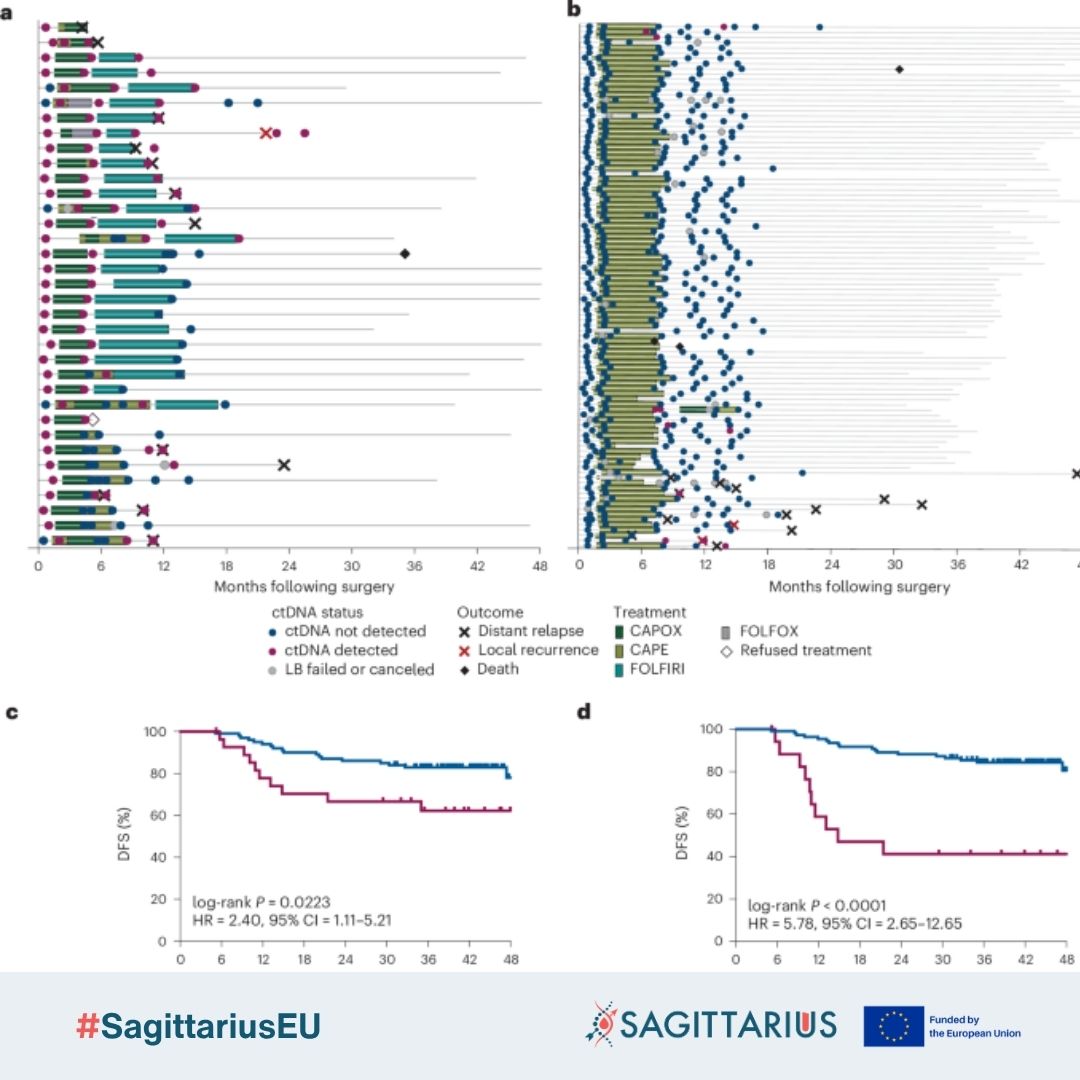
Landmark trial that set the stage for the SAGITTARIUS study demonstrated that liquid biopsy helps personalise post-surgery care in colon cancer. Final trial results were published on Nature Cancer.
How can clinicians determine which colon cancer patients truly need chemotherapy after surgery, and which could safely avoid unnecessary treatment? This question was at the heart of PEGASUS, a clinical trial led by SAGITTARIUS coordinator and sponsor IFOM. Its final results have now been published in the prestigious scientific journal Nature Cancer.
The study explored whether liquid biopsy could be used to detect traces of circulating tumour DNA (ctDNA) in the blood after surgery, and therefore guide treatment decisions according to each patient’s individual risk of recurrence. The findings represent an important step towards a more precise and personalised approach to colon cancer care.
Identifying patients at risk of recurrence
Following surgery for high-risk colon cancer, some patients still harbour microscopic residual disease that may eventually lead to recurrence, while others may already be cured by surgery alone. However, currently it is not possible to accurately distinguish between these groups, meaning that most patients receive the same adjuvant chemotherapy despite having very different levels of risk.
To address this challenge, PEGASUS investigated whether repeated ctDNA testing could help identify patients with molecular residual disease and adapt treatment intensity accordingly.
Between 2020 and 2022, despite the challenges posed by the COVID-19 pandemic, the study enrolled 135 patients with high-risk stage II and stage III colon cancer across 11 hospitals in Italy and Spain, including several SAGITTARIUS clinical partners and participating centers. Researchers analysed blood samples collected after surgery to detect ctDNA, a potential marker of residual cancer cells that remain invisible to conventional imaging.
Patients who tested negative for ctDNA in two consecutive blood samples received a less intensive treatment strategy without oxaliplatin, while ctDNA-positive patients received intensified therapy, with further treatment adaptations when ctDNA remained detectable.
Promising results for precision oncology
Approximately one quarter of participants (26%) were ctDNA-positive after surgery. Three years after treatment, outcomes differed substantially between the two groups.
Among the 100 ctDNA-negative patients, 83% remained disease-free and 94% were alive, despite receiving less intensive treatment. In ctDNA-positive patients, disease-free survival was approximately 62%, even after treatment intensification.
Although not conclusive, PEGASUS findings provide important evidence supporting the use of ctDNA as a tool for risk stratification after surgery. Also, researchers studied the biological mechanisms underlying cancers recurrence and observed that more personalised therapies may be beneficial for both ctDNA-positive and ctDNA-negative patients, opening new avenues for future research.
From PEGASUS to SAGITTARIUS
The lessons learned from PEGASUS are being translated into a larger and more ambitious clinical trial: SAGITTARIUS. It is enrolling patients across Italy, Spain and Germany, with approximately 650 already recruited to date.
Building on the evidence generated by PEGASUS, this Cancer Mission clinical study investigates two key questions: whether ctDNA-negative patients can be safely managed through intensive molecular surveillance rather than routine chemotherapy, and whether ctDNA-positive patients can benefit from personalised treatment strategies selected according to the genomic characteristics of their tumours, including targeted therapies and immunotherapy. As Scientific Coordinator Dr Silvia Marsoni explained, “With SAGITTARIUS, we are putting into practice what PEGASUS has taught us. We want to understand not only whether to treat patients after surgery, but also how to treat each patient in the most effective way.”
More about SAGITTARIUS
For further information on the SAGITTARIUS project or to participate in its trial, please get in touch with clinical.trials@ifom.eu.
To learn more:
- Media contact: info@sagittarius-horizon.eu
- Social media: LinkedIn, Facebook, X, Instagram, YouTube
- Subscribe to the SAGITTARIUS newsletter