
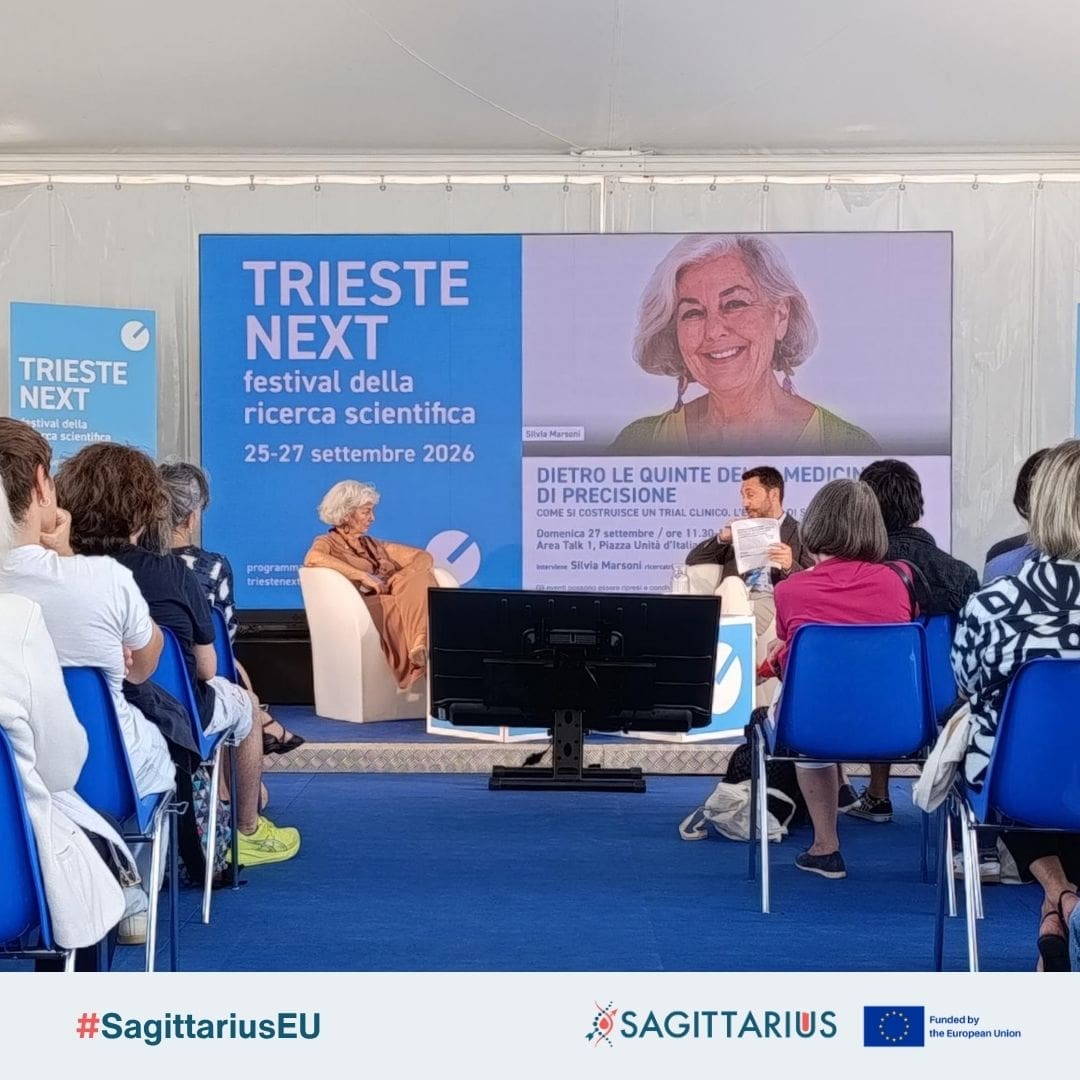
SAGITTARIUS experts brought audiences behind the scenes of tumour biology and clinical trial design.
Trieste, 26th-27th September
SAGITTARIUS was featured at Trieste Next 2026, one of Italy’s leading science and innovation festivals, held from 25th to 27th of September, in conjunction with the European Researchers’ Night. During the event, Dr Silvia Marsoni, Scientific Coordinator of SAGITTARIUS and Head of the Precision Oncology Unit at IFOM, and Dr Giorgio Patelli, medical oncologist, IFOM researcher and member of the SAGITTARIUS clinical network, took the stage by speaking in sessions that attracted a full audience.
SAGITTARIUS as an Example of Precision Medicine
Dr Silvia Marsoni took participants behind the scenes of clinical research in the session “Dietro le quinte della medicina di precisione: come si costruisce un trial clinico. L’esempio di SAGITTARIUS” – “Behind the Scenes of Precision Medicine: How to Design a Clinical Trial. The SAGITTARIUS Case”.
During the talk, she explained the need to personalize treatments to improve patients’ quality of life, and how clinical studies are fundamental to reaching these objectives and bringing basic research to the patients’ beds. Using SAGITTARIUS as a case study, she highlighted that developing a clinical trial requires years of work, particularly to define a study design capable of translating the latest scientific evidence, such as PEGASUS results, into clinical practice.
The discussion also underscored the challenges of conducting a highly personalised and pragmatic clinical trial. Identifying the right treatment pathway for each patient requires large numbers of participating patients, advanced technologies and close collaboration among researchers, clinicians, data scientists, patient representatives and clinical centres across Europe. This collaborative approach, that also lies at the heart of SAGITTARIUS, is essential for generating the evidence needed to bring precision medicine into routine care.
The participants were very participative, reflecting public interest in precision medicine and the future of cancer research, and the importance of creating dissemination opportunities.
Watch the full session here:
Better Understanding Cancer Timing
The SAGITTARIUS project was also represented in another key session at Trieste Next, “Questione d’età: i tempi del cancro” – “A Matter of Age: The Times of Cancer”, organised by Fondazione AIRC. Dr Giorgio Patelli, together with Francesco Neri, AIRC researcher and professor at Turin University, discussed the relationship between ageing and cancer, as well as the increasing incidence of certain cancers among younger populations. The discussion explored how research is helping to better understand cancer risk and develop new prevention and treatment strategies for the future.
Through his involvement in both clinical care and research activities, Dr Patelli brought valuable insight into the challenges and opportunities of precision oncology, reinforcing the importance of collaborative initiatives such as SAGITTARIUS in improving outcomes for people affected by colon cancer.
Watch the full session here:
The Importance of Dissemination
By participating in Trieste Next and the European Researchers’ Night, SAGITTARIUS contributed to bringing clinical research closer to citizens, fostering dialogue between researchers and the public, and increasing awareness of cancer and of how innovative oncology studies are designed and delivered across Europe.
More about SAGITTARIUS
For further information on the SAGITTARIUS project or to participate in its trial, please get in touch with clinical.trials@ifom.eu.
To learn more:
- Media contact: info@sagittarius-horizon.eu
- Social media: LinkedIn, Facebook, X, Instagram, YouTube
- Subscribe to the SAGITTARIUS newsletter